
How Hunting Apparel Brands Move from Prototype to Production
📌 Table of Contents
For hunting and outdoor brands, moving from prototype to production is not just a technical process. It is the stage where product ideas either move closer to real user needs — or drift away from them.
On paper, development often looks simple: define the product, make a sample, adjust a few details, then move into bulk. In reality, what determines success is not only whether a sample can be made quickly. It is whether that first sample is close enough to the intended result to help the brand make the right decisions early.
That matters because the final customer does not judge a garment by the tech pack. They judge it by what happens in the field. Does the jacket move well when reaching or drawing? Does the shell feel too stiff or too noisy? Do the trims feel secure? Does the fit still work over layers? Does the fabric hold up under real use? If those questions are not built into the sample stage, the development process may look busy while still moving in the wrong direction.
This is why prototype to production in hunting apparel is not only about execution. It is about building the first sample on logic that is already close to how the end user will actually wear, move in, and evaluate the product. This is also where a development-oriented manufacturing partner1 can make a meaningful difference.
Short Answer
In hunting apparel development, the value of a strong manufacturing partner is not only in bulk execution. It is in how close the first prototype gets to the intended result, because that shapes everything that follows — feedback quality, revision efficiency, development cost, and bulk readiness.
Prototype to production in hunting apparel usually includes product definition, tech pack and BOM development, fabric and trim sourcing, prototype rounds, PPS alignment, and the handoff into bulk. Most delays do not happen because sewing itself is too slow. They happen because the first sample is built on incomplete information, the wrong materials, unclear specifications, or late decisions that weaken the entire development process.
Who This Guide Is For
This guide is written for hunting and outdoor brand founders, product developers, and sourcing teams who want a more realistic understanding of how development works between the first product idea and bulk production.
It is especially useful for:
- brands building a new line
- teams refining a slow or expensive sample process
- smaller brands without a large internal development department
- companies that want to reduce unnecessary revision rounds without compromising product quality
If your goal is not only to get a sample made, but to get a first sample that is actually useful for decision-making, this guide is for you.
Why the First Prototype Matters More Than Many Brands Expect
Many brands treat the first prototype as a rough placeholder. In practice, it has a much bigger effect on the whole project than that.
A Better First Sample Creates Better Feedback
When the first sample is already reasonably close to the intended result, the brand can give feedback that is specific and useful. The team can comment on actual fit balance, mobility, handfeel, pocket placement, trim behavior, and end-user comfort.
When the first sample is too far from the target, feedback becomes much less productive. Instead of refining the product, the brand is forced to react to avoidable mismatches. Comments become broader, less structured, and more emotional. That makes every later sample round slower.
A Weak First Sample Multiplies Revision Rounds
If the first sample is built on the wrong logic, later rounds are often spent correcting direction rather than improving details. This is one of the main reasons development becomes inefficient. The issue is not always that there are “too many samples.” The issue is that the early samples were never strong enough to support good decisions.
The First Sample Should Reveal Real Problems, Not Artificial Ones
A sample should help the brand see the real product issues. But if the wrong fabric is used, the trim quality is off, or the specifications are too vague, the sample begins to create artificial problems. The team ends up reacting to issues that do not truly belong to the final product, but to the way the sample was built.
That is dangerous, because it wastes time while also distracting attention from what the end user will actually care about.
The Real Value Is Not Speed Alone, but Accuracy Early
Fast sampling is helpful, but speed alone does not define a strong development process. A fast first sample that is too far from the intended result can still create more delay later. Real value comes from early accuracy: getting close enough to the user-facing product direction in the first round that the rest of the development process becomes clearer, faster, and more reliable.
What Prototype to Production Really Means in Hunting Apparel
In hunting apparel, prototype to production is not just a factory sequence. It is a chain of decisions that connects product intent to real user performance.
That chain usually includes:
- defining the product brief
- clarifying the intended user and use case
- building the tech pack and BOM
- confirming fabrics and trims
- making the first prototype
- reviewing and revising the sample
- aligning PPS expectations
- handing the style into bulk with the right controls in place
This matters more in hunting apparel than in simpler categories because the garment is rarely judged on appearance alone. End users care about movement, silence, layering, weather protection, durability, comfort over time, and how the garment behaves under pressure. If those realities are not built into development early, the product may still look fine in the office while disappointing in the field.
For brands building technical outerwear, hybrid styles, or weather-sensitive products, this is also why the gap between sample logic and production reality matters so much2.
A Step-by-Step Development Path for Hunting Apparel Brands
Step 1 — Lock the Product Brief Before Sampling
Before the first sample is made, the brand should be as clear as possible about the intended use case. That includes target season, terrain, fit target, target price range, must-have features, and the type of hunter or outdoor user the product is being built for.
This is where many development problems quietly begin. A brand may know the look it wants, but not yet the exact performance logic behind it. The product may be intended for long glassing sessions, active stalking, upland movement, waterfowl exposure, or cold-weather stillness — and each of those creates different design priorities.
The stronger the brief, the more likely the first sample will be built on the right assumptions.
Step 2 — Build a Tech Pack and BOM That Reduce Guesswork in the First Sample
A tech pack and BOM are not only documentation. In practical development, they reduce guesswork.
This is especially important for younger brands. In many cases, the concept is strong, but the technical detail is not yet complete enough for smooth execution. When that happens, the first sample becomes more interpretive than it should be.
In hunting apparel, that is risky. If the first sample is built on too much guesswork, the brand may end up evaluating the wrong things. Instead of testing the intended product, the team is testing a partly improvised version of it.
The strongest sample processes are the ones where broad product intent is translated into enough detail that the first sample becomes genuinely decision-useful. This is also why early-stage brands often benefit from stronger development support before the first round of sampling starts3.
Step 3 — Source Fabrics and Trims with the First Sample in Mind
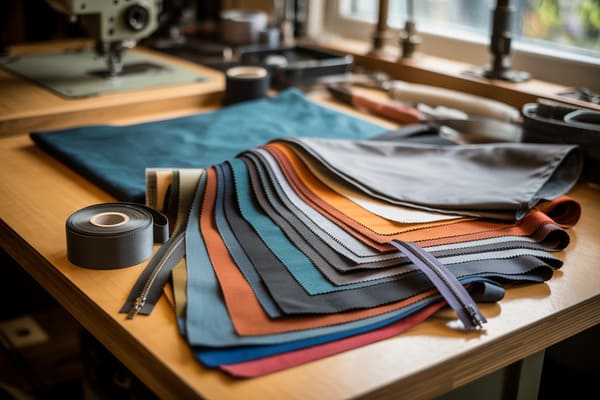
Fabrics and trims should not be treated as separate sourcing tasks. They directly shape whether the first prototype helps or misleads the development process.
The right fabric is not only the one with the right numbers on paper. It also needs the right handfeel, the right surface behavior, the right lamination effect if applicable, and the right compatibility with the intended construction. Brands working on waterproof or weather-protective outerwear often benchmark against established membrane and shell logic in the outdoor industry5. The same applies to trims. A zipper, cord lock, transfer label, snap, or hook-and-loop choice may look secondary on paper, but in a real garment, it strongly affects function and perceived quality. For example, water-repellent zipper systems such as AquaGuard® are often chosen for performance reasons, not just appearance6.
For the end user, these details are not minor. They influence comfort, usability, noise, trust, and overall product impression. That is why strong development does not just ask, “Can we source this?” It asks, “Will this help the first sample behave like the real product should?”
Step 4 — Use Prototype Rounds for Specific Decisions
Each sample round should serve a clear purpose.
The first prototype should test direction. It should answer whether the fit logic, material direction, feature placement, and overall product balance are moving toward the intended result.
A revision sample should solve defined issues. It should not reopen everything unless the first sample was fundamentally off track.
A pre-production sample should confirm production readiness. At that stage, the brand should be controlling details, not still discovering avoidable mismatches.
When every sample round has a clear decision role, development becomes more focused. When every round is treated as a broad review of everything, the process slows and the sample program becomes expensive without becoming sharper.
Step 5 — Align the Approved Sample with Bulk Reality
One of the most underestimated stages in hunting apparel development is the gap between sample approval and bulk readiness.
A sample can look right and still fail to translate cleanly into production if too many details remain open. Trim sizes, label application, seam treatments, sealing methods, measurement tolerance, reinforcement decisions, and packaging details all need to be aligned before bulk starts.
This is where many brands make a costly mistake: they assume sample approval means production is already safe. But from a user perspective, the product promise is only protected if the bulk garment still behaves like the approved sample.
Step 6 — Build Communication and QC into the Process Early
Communication and quality control are not final-stage tasks. They are part of development from the start.
If feedback arrives late, stays too general, or shifts direction from one round to the next, the whole project loses rhythm. If QC thinking appears only after bulk begins, the team is already too late.
In hunting apparel, many problems are not caused by sewing speed alone. They are caused by weak handoff points — between brand and factory, between one sample round and the next, and between sample approval and production reality.
What Brands Usually Get Wrong Between Prototype and Bulk
In our experience, many problems that appear later in development actually begin much earlier — when the first prototype is not built close enough to the intended result.
Mistake 1 — Trims Are Confirmed Too Late
Trims often look like small details, but in hunting apparel they can delay the whole project if they are not confirmed early enough.
One common example is heat-transfer labels or logos. A transfer may look acceptable at first, but once it is applied to the actual fabric, color migration may appear two or three weeks later. At that point, the brand may already be close to launch, and the trim solution has to be replaced.
Zippers are another common bottleneck. Sometimes the brand decides late that it wants a specific YKK zipper, only to realize the lead time is much longer than expected. In technical outerwear, that decision affects timing, consistency, and sometimes even overall product feel.
Elastic cords and cord locks create another frequent problem. A project may reach the pre-production sample stage before anyone realizes that the sourced cord and selected cord lock do not actually work together. The mismatch seems small, but it immediately reduces both function and product finish.
This is why trims should not be treated as final decoration. In technical hunting styles, they are functional decisions. The earlier they are checked in realistic use, the fewer delays they create later.
Mistake 2 — Fabric Confirmation Takes Longer Than Expected
Fabric confirmation often takes longer than brands expect, not because the material is unavailable, but because the right fabric has to be right in more than one way.
One issue is performance under real use. A fabric may look correct from the spec sheet, but if it has not been tested in practical conditions, it may fail on pilling, abrasion resistance, or waterproof performance. For hunting apparel, that gap between technical expectation and actual use can become a serious product problem.
Another issue is handfeel. Sometimes the numbers look fine, but once the fabric is made into a sample, the brand realizes that it feels too stiff, too noisy, too flat, or simply wrong for the end user.
A third issue appears with laminated fabrics. In some projects, the customer only realizes after lamination that the final color no longer looks right. At that stage, the material often has to be remade.
This is why fabric confirmation should not be treated as a simple sourcing step. In hunting apparel, it helps determine whether the first sample is actually useful or only creates more uncertainty.
Mistake 3 — The Specifications Are Not Detailed Enough
Another common problem is that the technical specifications are not detailed enough before sourcing begins.
This is especially common in early-stage brands. The product vision may be clear, but the technical information is not yet detailed enough to support smooth execution. In these cases, development becomes much more efficient when broad product intent is turned into workable first-round details, so the brand can react to a real garment instead of an incomplete concept.
Even when the overall design direction is right, incomplete specifications can cause major issues later. A trim may technically exist, but if its size does not match the intended garment part, the final result may look unresolved or function poorly. Pocket openings, adjustment systems, reinforcements, and weather-protection details all suffer when the early specs are too loose.
For the final user, these issues are not invisible. They change how the garment feels, how refined it looks, and whether it feels trustworthy in the field.
Mistake 4 — Materials Are Not Tested in Real Scenarios Early Enough
Even when the correct material is chosen on paper, development can still go wrong if that material is not tested in realistic conditions early enough.
In hunting apparel, the real standard is not whether the fabric looks correct on a desk. It is whether it performs as expected when worn, moved in, rubbed, folded, packed, washed, or exposed to real weather conditions.
This is where issues such as pilling, weak abrasion resistance, or waterproof performance below target tend to surface. The material may pass the early visual check, but fail once it enters realistic use.
This is also why relying only on sample appearance can be misleading. Materials should be evaluated not only for color and surface, but also for behavior. The earlier that gap is checked, the less likely it is to turn into a late-stage correction.
Most of these problems are not caused by lack of vision. They happen because many brands, especially lean teams, do not always have enough technical follow-up during the sample stage. For some brands, material confidence also includes responsible sourcing or product-safety frameworks such as OEKO-TEX® STANDARD 100 and bluesign®, especially when technical performance and material credibility need to move together78. That is why early development input matters so much: not because it removes every revision, but because it helps catch the expensive mistakes before they become production problems.
Where Hunting Apparel Development Timelines Actually Break
Most brands assume delays happen at the obvious stages — fabric sourcing, sample sewing, or bulk production. In practice, that is only part of the story. The real timeline breaks often happen in the handoff points.
Not at Sketch Stage, but at BOM and Trim Approval
The sketch stage is rarely the true bottleneck. In many projects, the bigger delays begin once BOM and trim decisions need to be finalized. When sourcing starts from incomplete decisions, the entire development rhythm becomes harder to control.
Not at Prototype Quantity, but at Unclear Feedback Loops
Sample rounds are not always what slows a project down. More often, it is unclear or delayed feedback. If comments stay too broad, arrive too slowly, or conflict between different decision-makers, every revision round becomes less productive. Teams move faster when feedback is narrowed into specific, user-relevant decisions.
Not at Bulk Sewing, but at Pre-Bulk Alignment
Many expensive problems do not begin in bulk sewing itself. They begin before that, when the handoff between approved sample and production reality is not tight enough. The strongest projects treat this stage as a control stage, not a discovery stage.
Not at Technical Complexity Alone, but at Too Many Moving Parts
Technical products do take longer, but complexity alone is rarely the whole problem. Timelines usually break when too many material, trim, fit, and construction decisions are still moving at the same time. A project with new fabric, new trims, new logo execution, new pattern logic, and wide size development all at once is much harder to stabilize.
What a Realistic Hunting Apparel Development Timeline Looks Like
Brands often ask how long development should take. There is no single answer, because timelines depend on product complexity, material readiness, trim approval speed, and decision efficiency. But most projects fall into three broad rhythms.
Fast-Track Development
Fast-track development is possible when the style is relatively mature, the materials are already clear, trims are standard, and the brand’s internal decision chain is fast. These projects usually involve fewer structural unknowns and fewer moving parts. Fast-track timing works best when the product is already close to something proven.
Standard Development
This is the most common rhythm. The line has a clear direction, but still needs normal sample rounds, material confirmation, fit adjustment, and internal review. This is where brands often underestimate how much buffer is needed around trim approval, fit comments, and pre-bulk alignment.
Complex Technical Outerwear Development
This includes products such as 3-layer seam-sealed jackets, insulated shells, hybrid garments, or styles using more advanced construction methods. These projects naturally require more confirmation points, more compatibility checks, and more careful alignment between sample and bulk. They should not be scheduled as if they were simple garments.
How Stronger Early Decisions Reduce Rework Later
The strongest development processes do not eliminate all revisions. What they do is reduce the revisions that exist only because the early logic was weak.
Push Critical Decisions Forward
Some decisions simply cannot wait. Fabric direction, trim compatibility, construction logic, and labeling choices all affect the usefulness of the first sample. The earlier these are clarified, the less rework is created later.
Separate Need-to-Decide-Now from Can-Wait
Not every detail must be finalized immediately. But the wrong details cannot stay open for too long. Stronger development rhythm comes from separating what must be decided now from what can still be optimized later.
Make Feedback More Specific Earlier
Vague feedback wastes time. Specific feedback moves development forward. Comments work best when they identify the exact issue, the garment area involved, and the intended correction. A first sample that is already close to the target also makes this much easier.
Treat PPS as a Control Stage, Not a Discovery Stage
PPS should confirm that the agreed solution is production-ready. It should not be the stage where the brand first discovers that trims do not match, materials do not feel right, or construction choices still have unresolved issues. When PPS is treated as a control stage, the transition into bulk becomes much safer.
Frequently Asked Questions
How many sample rounds are normal in hunting apparel development?
There is no fixed number, because it depends on product complexity, material readiness, and how strong the first sample is. Simpler products may move with fewer rounds, while technical outerwear usually needs more. In practical terms, strong first-sample accuracy matters more than chasing the lowest number of rounds.
What usually delays prototype-to-production timelines?
The most common causes are not always sewing speed. More often, delays come from incomplete BOMs, trims confirmed too late, fabric decisions that change after sampling, vague fit comments, or weak pre-bulk alignment.
When should trims be finalized?
The critical trims should be reviewed as early as possible, especially if they affect fit, function, usability, or lead time. Heat-transfer labels, zippers, adjustment components, and cords should not be left until the last stage, because small trim issues often become large timeline problems later.
How do MOQ and fabric choice affect development speed?
MOQ and fabric choice often shape the entire rhythm of development. The more custom the fabric or trim program becomes, the more likely the lead times and decision points expand. This is why MOQ strategy4 and realistic material planning matter so much early on.
What is the difference between a fit sample, a development sample, and a PPS?
A fit sample focuses primarily on silhouette, proportion, and movement. A development sample tests broader product logic, including materials, trims, and construction choices. A PPS should confirm that the agreed solution is ready for bulk, which is why it should function more as a control stage than a discovery stage.
Why do technical outerwear projects usually take longer?
Because they involve more moving parts. Waterproof construction, seam sealing, insulation behavior, lamination effects, trim compatibility, and bulk-to-sample consistency all require more confirmation than simpler garments. The more technical the product, the more important early accuracy becomes.
Final Thoughts
Prototype to production in hunting apparel is not one action. It is a chain of decisions, and the quality of those decisions determines whether development feels efficient or exhausting.
For hunting and outdoor brands, the most important question is not only how fast a sample can be made. It is how close that first sample gets to the intended result. A stronger first prototype creates better feedback, reveals more useful problems, and reduces unnecessary rework later.
That is where real development value appears — not just in making garments, but in making the early decisions strong enough that the product stays closer to what the brand wants and closer to what the end user will actually value in the field.
References
[1] Your Expert Hunting Apparel Manufacturer & Development Partner 1
[2] 3-Layer Seam Sealed Jackets | Hi-nect 2
[3] How to Choose the Right Hunting Apparel Manufacturer for Your Brand 3
[4] Lowering MOQs: A Guide for Hunting & Outdoor Brands 4
[5] The GORE-TEX Product Range 5
[6] AquaGuard Collection | YKK 6
[7] OEKO-TEX STANDARD 100 7
[8] Sustainability Services for Fashion Brands & Retailers | bluesign 8
Ready to elevate your outdoor apparel line?
Let’s talk. We offer flexible MOQ, fast samples, and expert guidance — get your quote today.
You may also be interested in:

A Hunter's Guide to Waterproof & Breathable Fabric Science
A Hunter’s Guide to Waterproof & Breathable Fabric Science For hunting and outdoor brands, waterproof and breathable fabric is never

Lowering MOQs: A Practical Guide for Hunting & Outdoor Brands
For many hunting and outdoor brands, MOQ is not just a pricing issue. It is often the first real supply-chain

Top 13 Hunting Apparel Manufacturers 2026
When buyers search for hunting apparel manufacturers, they are often looking for more than one thing at the same time.