How to Choose the Right Hunting Apparel Manufacturer for Your Brand
📌 Table of Contents
Choosing a hunting apparel manufacturer looks straightforward at the beginning. You compare a few quotes, ask about MOQ, review sample photos, and move forward.
In real projects, it is rarely that simple.
After more than 15 years in performance and hunting apparel, I have seen brands lose time, margin, and sometimes an entire season not because the product idea was weak, but because the manufacturer was the wrong fit. The first email looked fine. The quote looked acceptable. The sample looked promising. The real problems showed up later, when revisions slowed down, when fabrics or trims no longer matched the original expectation, or when bulk production drifted away from the approved sample.
That is why this decision matters so much. In hunting apparel, manufacturing is not just execution. It affects product credibility, development speed, field performance, and the long-term trust a brand can build with its customer. This is exactly where a capable manufacturing partner1 starts to matter.
Short Answer
The right hunting apparel manufacturer is not simply the one with the lowest quote or the fastest first reply. It is the one whose product understanding, development support, MOQ structure, sampling speed, quality control, and communication style match your brand’s stage and the kind of product you are trying to build. A strong manufacturer should understand hunting-specific construction, handle revisions clearly, support technical decisions during development, and keep bulk production close to the approved sample. Price matters, but it should be judged together with consistency, responsiveness, and long-term fit.
Why This Decision Matters More in Hunting Apparel
Hunting apparel is not basic apparel.
A hunting shell is asked to manage weather protection, mobility, durability, and comfort at the same time. In many cases, the garment also has to deal with silence in movement, pocket logic that still works with gloves or layered systems, and functional trims that can hold up in the field. Technical outerwear systems built around waterproofness, windproofness, and breathability are now well understood in the outdoor industry2, but translating those requirements into a product that is realistic to develop and manufacture is where many brands get stuck.
A supplier that mainly produces fashion outerwear may still be able to sew a jacket. That does not mean it understands the trade-offs behind a hunting garment. It may not know when a brushed face fabric is worth the compromise, when a waterproof zipper is necessary, or when a pocket placement creates bulk, noise, or access issues in actual use.
This is why the better question is not, “Can this factory make apparel?” It is, “Can this manufacturer help this specific product succeed?”
1. Make Sure They Truly Understand Your Product Category
Start with category understanding, not with price.
There is a real difference between a manufacturer that can sew garments and one that understands hunting apparel as a product category. A supplier may have experience with padded jackets, uniforms, or casual outerwear and still struggle with the logic behind a quiet hunting shell, a highly mobile field pant, or a technical 3-layer jacket with full seam sealing3.
A manufacturer with relevant category understanding should be comfortable discussing things like:
- the difference between softshell and hardshell use cases
- how different backers affect comfort and noise
- why seam sealing helps in one design but adds unnecessary complexity in another
- how fabric weight and lamination change the feel of a hunting garment
- how pocket logic, hood shape, cuff structure, and articulation affect use in the field
- how water-repellent zipper options such as AquaGuard® are typically used in apparel4
A good early test is to show them a style and ask where they see development risk. If the answer stays generic, that tells you something. If the answer becomes more specific and product-based, you are probably talking to someone with real category familiarity.
2. Look at Development Capability, Not Just Production Capacity
Production capacity matters, but only after the product is ready.
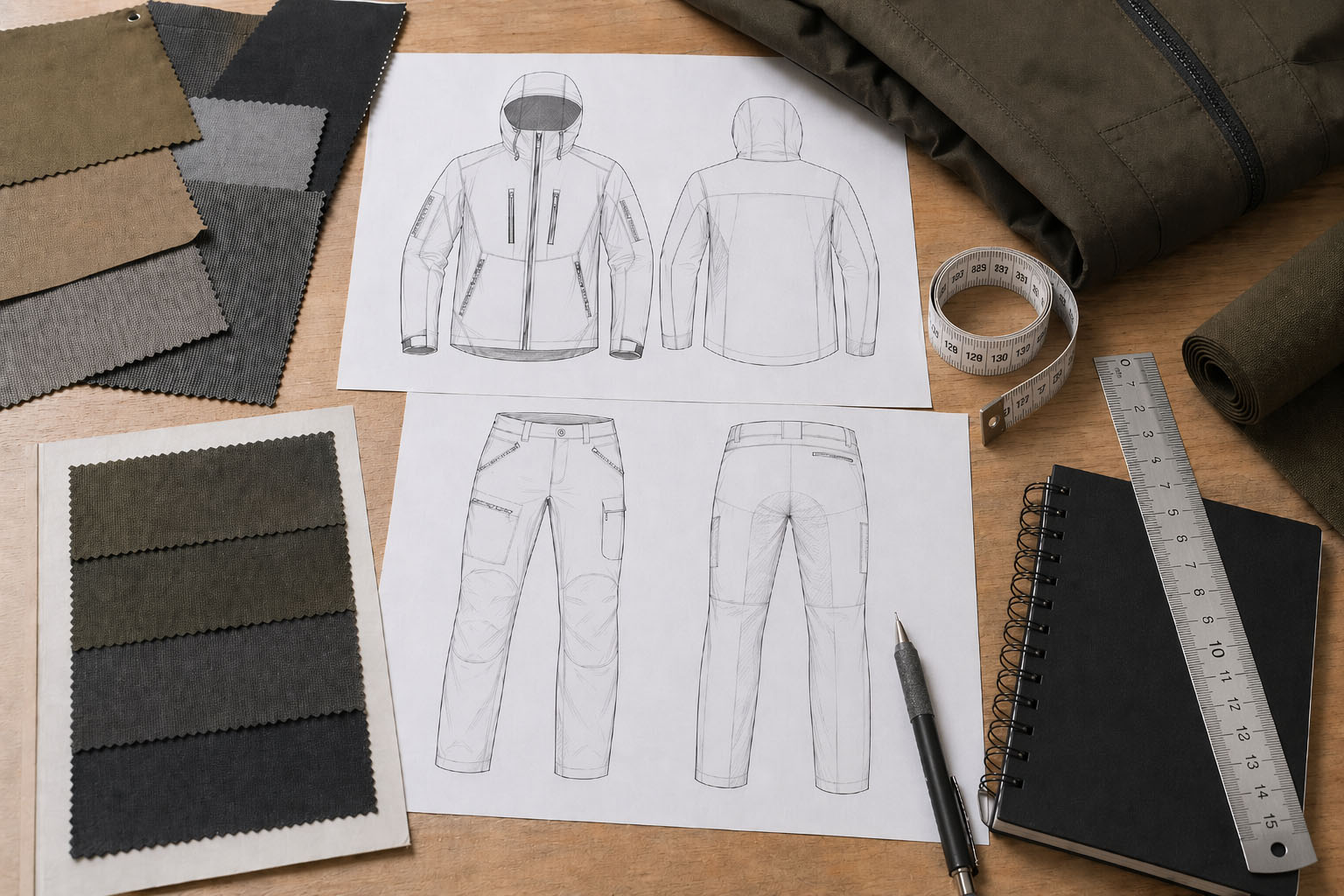
Many delays begin much earlier. A tech pack may be incomplete. A fabric may look right on paper but fail in real use. A construction detail may create bulk, stiffness, or leakage. A trim may meet the visual target but not the functional one. None of these issues are unusual. What matters is whether the manufacturer can help you move through them.
That is development capability.
A development-capable manufacturer should be able to do more than follow instructions. They should be able to review what is on the page, identify what may become a problem in reality, and propose workable alternatives without losing sight of the product goal. The value of a structured prototype-to-production process becomes obvious here5.
In practical terms, I would look for signs such as:
- Can they read and respond to a technical package with useful comments?
- Can they suggest alternative fabrics or trims when the original target is risky, unavailable, or too expensive?
- Can they explain why a construction option may affect cost, noise, comfort, or durability?
- Can they build a first prototype in a way that helps decision-making instead of simply producing a sample?
- When comments come back, do they handle revisions in a clear and methodical way?
This is often the difference between a factory and a partner.
3. Evaluate MOQ in the Context of Your Brand Stage
MOQ is one of the first questions every brand asks. It should be.
But MOQ should not be judged in isolation.
A low MOQ can be extremely helpful, especially for an early-stage brand or for a new style test. At the same time, MOQ is rarely just a number picked at random. It usually reflects material minimums, trim minimums, dye lot realities, production efficiency, and the way a manufacturer structures small-batch work. That is why the more useful question is not, “Who offers the lowest MOQ?” It is, “Which MOQ structure makes sense for my brand at this stage?”
This is exactly the point I would connect to a deeper MOQ discussion6.
For an early-stage brand, flexibility often matters more than pure price. You may still be testing demand, learning from the market, and managing inventory risk carefully.
For a growing brand, MOQ still matters, but the conversation changes. You may accept a higher MOQ if it brings better material access, more stable pricing, or smoother production planning.
For a mature brand with repeat business, MOQ is usually less about access and more about margin, continuity, and supply chain efficiency.
The mistake many teams make is assuming that the lowest MOQ is always the best outcome. Sometimes it comes with weaker material choices, higher unit pricing, or a factory structure that is not built for long-term stability. The better manufacturer is usually the one who can explain MOQ honestly in the context of your business stage.
4. Ask Hard Questions About Sampling Speed and Revision Efficiency
Speed matters, but in development, speed has to be defined properly.
A supplier may tell you the first sample takes seven to ten days. That number sounds good, but it does not tell you enough. A better way to judge sampling speed is to look at the full rhythm of the process.
Ask questions such as:
- How long does the first proto usually take once materials are confirmed?
- How are comments handled after fitting or review?
- How long do revision rounds usually take?
- What tends to delay development most?
- How are sample changes communicated back to the brand?
In real projects, delay is often not caused by sewing time alone. It may come from waiting on trims, unclear comments, weak internal follow-up, or substitution issues that were not flagged early enough. That is why revision efficiency is often a better signal than first-sample speed.
A good manufacturer should be able to move comments into action without losing detail. They should be able to separate critical changes from cosmetic ones, highlight what has been updated, and explain what still needs confirmation.
That sounds basic. In practice, it saves a lot of time.
5. Look Beyond the Unit Price
Of course price matters.
But if you are comparing manufacturers only by unit price, you are probably not comparing the full cost of the decision.
I usually think about at least four costs that deserve more attention:
Communication cost
A lower quote becomes expensive very quickly when simple issues take too many emails to clarify, or when every comment round creates new misunderstandings.
Remake cost
If the factory does not understand the product or cannot handle revisions well, you may end up paying for extra rounds directly or indirectly through time lost.
Delay cost
For seasonal categories, delay does not just affect production. It affects launch timing, sell-in meetings, samples for sales teams, and sometimes the relevance of the product itself.
Inconsistency cost
A cheap sample that turns into a weak bulk order is rarely cheap in the end. The cost of inconsistency shows up in claims, discounting, damaged trust, or lower repeat business.
That is why I would never compare hunting apparel manufacturers on quote alone. The lower quote is not always the lower-risk decision.
6. Review Their Quality Control and Sample-to-Bulk Consistency
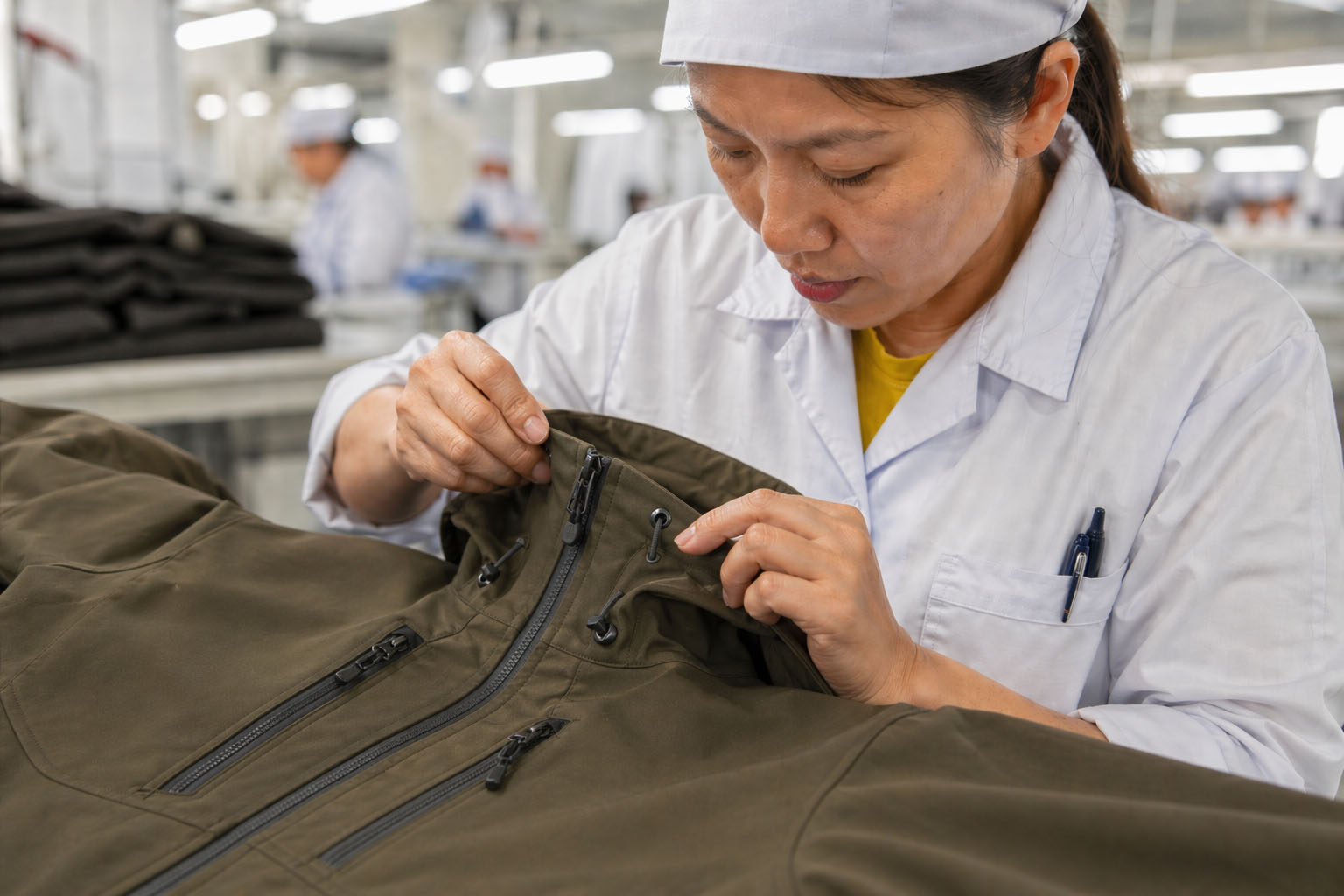
Almost every supplier says they have quality control. The useful question is how that quality control actually works.
For hunting apparel, sample-to-bulk consistency matters more than many teams expect. A brand may approve a sample based on fit, hand feel, construction, trim choice, and overall confidence in the product. If the bulk order drifts away from that approved standard, the problem is not only technical. It becomes a trust problem.
I would ask about:
- fabric and trim confirmation before production
- pre-production sample discipline
- measurement checks during bulk production
- in-line inspection routines
- final inspection structure
- how changes between approved sample and mass production are controlled
If sustainability, chemical management, or social compliance matter to your brand, this is also the stage where I would ask what third-party frameworks the manufacturer works with. For responsible textile sourcing, bluesign® is one of the clearest external systems to understand7. For finished-product safety, OEKO-TEX® STANDARD 100 is a widely recognised benchmark8. For supply-chain social compliance conversations, amfori BSCI is also commonly referenced in sourcing discussions9.
A factory with a real QC system usually has clear answers to these questions. Not necessarily long answers. Just real ones.
7. Pay Attention to How They Communicate Before You Place the Order
I pay a lot of attention to communication very early, because it usually tells you more than the presentation deck does.
A manufacturer’s communication style before the order often predicts what the working relationship will feel like later.
If replies are vague now, they may stay vague later. If questions are avoided now, they may still be avoided later. If nobody flags risk during development, that silence may continue during production, and that is where problems become expensive.
What I look for is simple:
- Are they clear?
- Are they specific?
- Do they answer the actual question?
- Do they identify risk early?
- When something is difficult, do they explain why and offer options?
That last point matters a great deal.
In real manufacturing, not everything goes perfectly to plan. Materials change. Minimums create pressure. Construction details affect cost. Sample comments reveal problems. A strong manufacturer is not valuable because nothing ever goes wrong. They are valuable because they communicate early, explain clearly, and help you decide what to do next.
Match the Manufacturer to Your Brand Stage
One of the biggest sourcing mistakes is looking for a “best factory” in the abstract.
There is no single best manufacturer for every brand.
The better question is: best for what stage, what product, and what kind of working model?
Early-stage brands
If you are still shaping your first collection or testing the market, flexibility matters. You are more likely to need realistic MOQ, development support, clear guidance on materials, and a team that can help you make decisions without adding unnecessary complexity.
Growing brands
At this stage, you usually need smoother execution. Development still matters, but repeatability starts to matter more. You want better structure around comments, clearer cost logic, and a factory that can help you move from one-off development into something more stable.
Established brands
Here, the focus often shifts toward consistency, process discipline, sourcing strength, and scalability. The key question is not whether the manufacturer can make one good sample. It is whether they can deliver the same standard over time, across repeat orders, colourways, and seasonal programs.
A manufacturer can be excellent for one stage and not ideal for another. That is normal. The goal is not to find the most impressive factory profile. It is to find the fit that allows your brand to move well from where you are now to where you want to be next.
A Final Checklist Before You Decide
Before making the final call, I would ask these seven questions:
- Do they clearly understand the kind of hunting product I am building?
- Can they support development, not just execute instructions?
- Is their MOQ workable for my current brand stage?
- Are their sampling and revision timelines clear and realistic?
- Am I comparing total project value, not only unit price?
- Do they have a real method for maintaining sample-to-bulk consistency?
- Does their communication style give me confidence for a long-term working relationship?
If you cannot answer most of these with confidence, it is probably too early to commit.
Frequently Asked Questions
What should I ask a hunting apparel manufacturer before starting a project?
Ask about relevant product experience, MOQ, sample lead time, revision handling, material sourcing, quality control, and how they manage sample-to-bulk consistency. It also helps to ask what they see as the biggest development risk in your style.
Is a low MOQ always better?
Not always. A low MOQ can be useful, especially for new brands, but it can also come with higher pricing, more limited material choices, or weaker production efficiency. The better question is whether the MOQ fits your current stage and business model.
How long should sample development usually take?
That depends on the product and material readiness, but what matters more than the first-sample number is the full rhythm of revision. A fast first proto means little if every comment round becomes slow or unclear.
Should I choose OEM, ODM, or a development partner?
That depends on how much product direction your brand already has. If your concept and tech pack are very clear, OEM may be enough. If you need design support, construction suggestions, or flexible development input, a stronger development partner is often more useful10.
How can I tell if a factory is good at hunting apparel specifically?
Look at how they talk about the product. Do they understand functional use, fabric behaviour, field details, and construction trade-offs? Category knowledge usually shows up in the specificity of their questions and answers.
Conclusion
Choosing the right hunting apparel manufacturer is rarely about finding a perfect factory. It is about finding the right fit for the product you are building, the stage your brand is in, and the kind of working relationship you want to build over time.
In my experience, the best partnerships are usually not the ones that look the cheapest or easiest in the first comparison sheet. They are the ones that hold together under real development pressure — when comments get detailed, when timelines tighten, when cost needs adjustment, and when consistency starts to matter more than promises.
If you are evaluating manufacturing options now, I would compare beyond the quote. Look at how the team thinks, how they communicate, how they solve problems, and how well their structure fits the brand you are trying to build. If you want more context before making that decision, these two pieces are the next logical reads: our detailed MOQ guide6 and our article on moving from prototype to production5.
References
[1] Your Expert Hunting Apparel Manufacturer & Development Partner 1
[2] The GORE-TEX Product Range 2
[3] 3-Layer Seam Sealed Jackets | Hi-nect 3
[4] AquaGuard Collection | YKK 4
[5] From Prototype to Production: Accelerating Your Hunting Gear Development 5
[6] Lowering MOQs: A Guide for Hunting & Outdoor Brands 6
[7] Sustainability Services for Fashion Brands & Retailers | bluesign 7
[8] OEKO-TEX STANDARD 100 8
[9] BSCI for Producers | amfori Support 9
[10] About Us | Hi-nect 10
Ready to elevate your outdoor apparel line?
Let’s talk. We offer flexible MOQ, fast samples, and expert guidance — get your quote today.